

PATHOLOGY
Behind the Microscope: DD Hospital's State-of-the-Art Pathology Laboratory and Its Vital Role in Patient Care
# Behind the Microscope: DD Hospital’s State-of-the-Art Pathology Laboratory and Its Vital Role in Patient Care
In modern healthcare, timely and accurate diagnoses form the cornerstone of effective treatment. While patients may rarely encounter pathologists directly, the work performed in hospital pathology laboratories profoundly impacts medical decision-making and patient outcomes. DD Hospital’s Department of Pathology stands at the forefront of diagnostic excellence, combining cutting-edge technology with unparalleled expertise to deliver precise results that guide clinical care across all medical specialties.
## The Essential but Often Invisible Role of Pathology
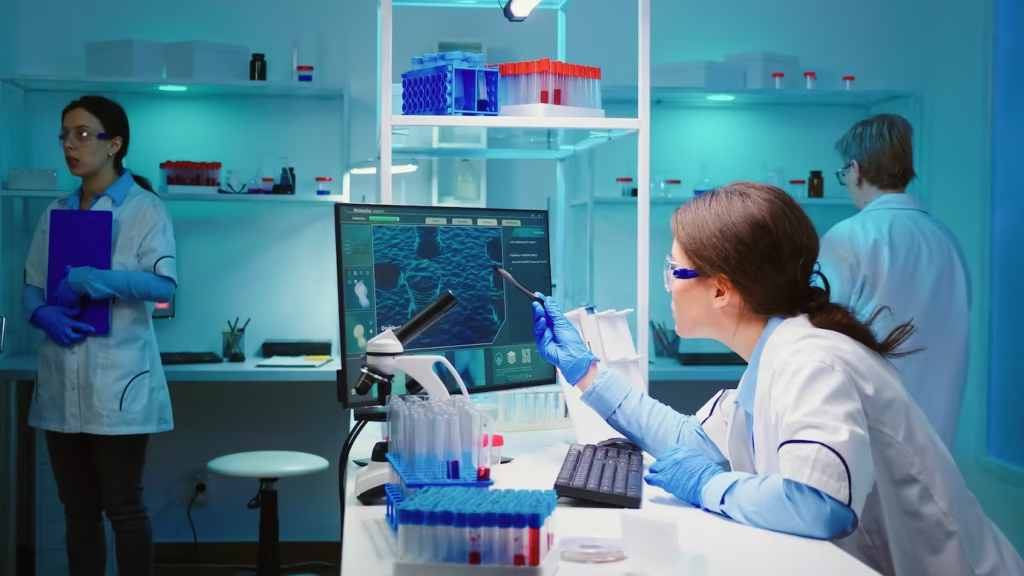
Pathology represents the bridge between basic medical science and clinical practice. At DD Hospital’s Pathology Laboratory, highly trained specialists examine tissue samples, bodily fluids, and cells to identify disease processes with remarkable precision.
“Though patients may never meet their pathologist, we’re intimately involved in their care journey,” explains Dr. Rebecca Chen, Director of Pathology Services at DD Hospital. “Approximately 70% of all medical decisions rely on laboratory results. We provide the critical diagnostic information that physicians need to make informed treatment decisions.”
The laboratory’s comprehensive services encompass:
– **Surgical Pathology**: Examination of tissue removed during surgery or biopsy
– **Cytopathology**: Analysis of cell samples, including Pap smears and fine needle aspirations
– **Hematopathology**: Diagnosis of blood diseases and disorders
– **Molecular Pathology**: Genetic and molecular testing for personalized medicine
– **Microbiology**: Identification of infectious agents
– **Clinical Chemistry**: Analysis of blood and body fluids for chemical abnormalities
– **Immunopathology**: Detection of immune system disorders
– **Autopsy Services**: Postmortem examinations for clinical and educational purposes
## Technological Excellence at DD Hospital’s Pathology Laboratory
DD Hospital has invested significantly in advanced pathology technologies that enhance diagnostic accuracy and efficiency:
**Digital Pathology Systems**: The transition from glass slides to digital imaging has revolutionized the laboratory’s workflow. “Digital pathology allows for instantaneous consultation with specialists worldwide,” notes Dr. James Wilson, Chief of Digital Pathology. “Complex cases can now be reviewed by multiple experts simultaneously, regardless of geographic location, significantly reducing diagnostic turnaround times.”
**Artificial Intelligence Integration**: DD Hospital has pioneered the implementation of AI-assisted diagnostic tools. These systems function as “digital assistants” that help pathologists identify patterns and abnormalities that might otherwise be overlooked.
**Advanced Molecular Diagnostics**: The laboratory’s molecular pathology section utilizes next-generation sequencing technologies to analyze genetic mutations at an unprecedented level of detail. “These capabilities are particularly crucial in oncology,” explains Dr. Sarah Patel, Head of Molecular Pathology. “By identifying specific genetic alterations in tumors, we can help oncologists select targeted therapies with greater efficacy and fewer side effects than traditional approaches.”
**Rapid Testing Platforms**: For time-critical diagnoses, DD Hospital employs point-of-care testing technologies that deliver results within minutes rather than hours or days. These rapid diagnostics are especially valuable in emergency medicine, surgical settings, and intensive care units.
## Key Benefits of DD Hospital’s Pathology Services
### 1. Exceptional Diagnostic Accuracy
The laboratory maintains rigorous quality control protocols that exceed national standards. “Our diagnostic accuracy rates consistently rank among the highest in the nation,” notes Dr. Chen. “This precision is achieved through multiple layers of verification, including automated quality checks and secondary review of all critical diagnoses.”
The department’s subspecialty expertise further enhances diagnostic precision. Each pathologist focuses on specific organ systems or disease processes, developing unprecedented depth of knowledge in their area of specialization.
### 2. Rapid Turnaround Times
DD Hospital’s Pathology Laboratory has implemented streamlined workflows that dramatically reduce testing times without compromising quality.
“Our average turnaround time for routine biopsies is 24-48 hours, compared to the national average of 3-5 days,” explains Dr. Michael Rodriguez, Laboratory Operations Director. “For urgent cases, we can often deliver preliminary results within hours. This efficiency directly translates to faster treatment initiation and improved patient outcomes.”
### 3. Multidisciplinary Collaboration
Pathologists at DD Hospital are integral members of disease-specific treatment teams. They participate in regular tumor boards, clinical conferences, and patient care meetings, ensuring that laboratory findings are properly interpreted within the full clinical context.
“We’ve moved beyond the traditional model where pathologists remain isolated in the laboratory,” says Dr. Patel. “Our active participation in multidisciplinary teams ensures that diagnostic information is translated effectively into clinical action.”
### 4. Patient-Centered Reporting
Recognizing that laboratory results can be confusing and anxiety-provoking for patients, DD Hospital has developed innovative approaches to make pathology reports more accessible.
“We’ve implemented a dual-reporting system,” explains Dr. Wilson. “Physicians receive comprehensive technical reports, while patients can access simplified explanations through our secure patient portal. These patient-friendly reports use clear language and visual aids to help individuals understand their test results.”
### 5. Research and Innovation
The Pathology Department maintains an active research program that translates scientific advances into clinical applications. Current research initiatives include:
– Development of liquid biopsy techniques for non-invasive cancer detection
– Validation of new biomarkers for early disease identification
– Implementation of machine learning algorithms to enhance diagnostic accuracy
– Exploration of spatial genomics to understand disease at the cellular level
“Our research mission is deeply intertwined with our clinical practice,” notes Dr. Chen. “By operating at the cutting edge of pathology science, we bring tomorrow’s diagnostic technologies to today’s patients.”
## The Critical Role of Pathology in Specific Clinical Scenarios
### Cancer Diagnosis and Treatment
Perhaps nowhere is the value of expert pathology more evident than in oncology. DD Hospital pathologists precisely classify tumors based on their microscopic appearance, molecular features, and genetic profiles.
“Modern cancer treatment has become increasingly personalized, tailored to the specific characteristics of each patient’s tumor,” explains Dr. Patel. “Our comprehensive molecular tumor profiling identifies therapeutic targets and helps predict which treatments will be most effective for individual patients.”
This precision approach has significantly improved outcomes for many cancer patients at DD Hospital, with targeted therapy selection increasing response rates by 30-40% for certain malignancies.
### Infectious Disease Management
The microbiology section plays a crucial role in identifying infectious agents and determining appropriate antimicrobial therapies. During the recent pandemic, DD Hospital’s Pathology Laboratory rapidly implemented testing protocols that provided results within hours.
“Our advanced molecular detection methods can identify pathogens that are difficult or impossible to grow in traditional cultures,” notes Dr. Rodriguez. “This capability is particularly valuable for immunocompromised patients and those with unusual or severe infections.”
### Intraoperative Consultation
During surgery, pathologists provide real-time guidance through frozen section analysis. This rapid assessment helps surgeons determine whether they have completely removed diseased tissue or need to extend the surgical margins.
“Our frozen section accuracy rate exceeds 98%, well above the national benchmark,” says Dr. Wilson. “This level of precision gives surgeons confidence in making critical intraoperative decisions.”
## Looking to the Future
DD Hospital’s Pathology Laboratory continues to evolve, embracing emerging technologies and expanding its services. Future initiatives include:
– Implementation of spatial genomics capabilities for more precise tumor characterization
– Expansion of the digital pathology network to enhance collaboration with regional hospitals
– Development of AI-enhanced diagnostic algorithms for rare diseases
– Integration of pathology data with the hospital’s comprehensive electronic health record system
## Conclusion
Though often working behind the scenes, DD Hospital’s pathologists and laboratory professionals play an indispensable role in patient care. Through their diagnostic expertise, technological innovation, and collaborative approach, they provide the critical information that guides treatment decisions across all medical specialties.
“Every tissue sample and laboratory specimen represents a patient waiting for answers,” reflects Dr. Chen. “We never lose sight of the human impact of our work, and we remain committed to delivering the most accurate, timely, and clinically relevant diagnostic information possible.”
For physicians seeking pathology services or patients with questions about laboratory testing at DD Hospital, please contact the Department of Pathology at (555) 123-4567 or visit our website at www.ddhospital.org/pathology.
